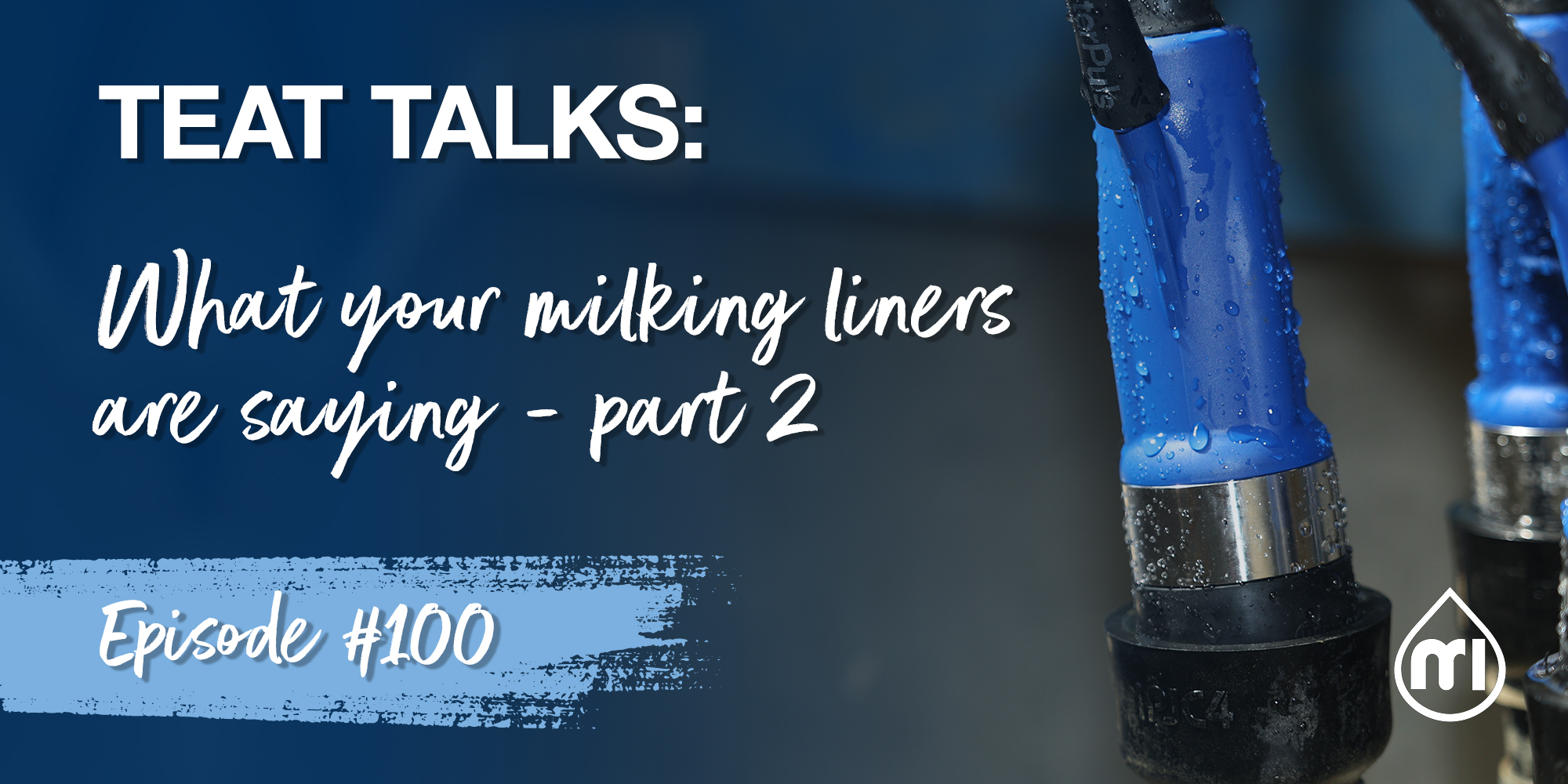
Teat talks: what your milking liners are saying – Part 2
Listen to this article!
Teats send us signs which, taken alone, might seem minor. However, together, they form a language about your liners. On the 100th MI blog article, we guide you in understanding what’s really happening beneath the surface. Keep on reading, there is a lot you can benefit from!
The importance of time
The milking process, though seemingly simple, is a complex dance of forces. The liner opens to allow milk to flow. It collapses to massage the teat and encourage circulation. It does this dozens of times per minute, in coordination with vacuum and pulsation.
When the liner functions well, it supports healthy blood flow, maintains teat integrity, and removes milk efficiently. But when it malfunctions or wears out, the consequences accumulate quietly.
Over time, liners lose tension. Their collapse becomes irregular. Instead of a smooth massage, they pinch or flutter. Milk flow becomes inconsistent. The vacuum required to maintain milking increases, adding strain to the teat. And inside the liner itself, tiny cracks begin to form, becoming perfect homes for bacteria.
Research carried out by Wieland and colleagues explored how automatic cluster removers, when calibrated correctly, could dramatically reduce the time teats are exposed to vacuum once milk flow has ceased. But if those settings are off, or if liners aren’t replaced on time, that advantage disappears.
It’s not just about performance anymore. It’s about physiology: every extra second matters.
What liners reveal about the farm
"Something I’ve come to believe after decades in parlours across the world is that liners are more than tools. They’re reflections. They reveal, in quiet and subtle ways, the culture of the farm itself.
When I walk into a milking parlour and see liners that are changed by the calendar, tracked by milkings, chosen based on cow type, I see a farmer who respects biology, who sees each cow not as a number but as an individual.
When I visit a farm where liners are clearly overused, where teat ends are rough, where cows shuffle uneasily, I see overload. I see a team stretched thin, systems overrun, and good intentions swallowed by the day-to-day pressure.
Your liners tell me how you care. They tell me whether your equipment is aligned with your ethics. Whether the process honours the animal or merely extracts from her."
The hidden sustainability of teat comfort
There’s another conversation happening beneath all this, one we often overlook when we talk about sustainability. We speak of carbon footprints, water usage, and methane emissions. But here’s a quiet truth: every healthy teat is a sustainability win.
A cow with intact teat ends is less likely to develop mastitis. She will need fewer antibiotics. She will stay in the herd longer. She will give more milk across more lactations, reducing the need for replacements. Her efficiency rises, and with it, the sustainability of the entire system.
Changing liners on time is not just good practice: it’s a low-cost climate strategy. It’s animal welfare in action. It’s your liner telling the world: “This farm pays attention. This farm understands what matters.”
The parlour isn’t just about production
The parlour is not just a place of production. It is a place of partnership. And in this partnership, the cow speaks softly, but clearly. Her teats tell the story, while the liners are translators. And if you tune in closely, you’ll find that the cows have been trying to tell you something all along.
MI thanks Joao Pereira for the input.
As mentioned in the opening, we reached the 100th blog episode, and you were the real engine of this journey.
Therefore, we would like to thank you for trusting and inspiring us. Make sure to stay tuned on our social media accounts, as some rewards are coming!
Follow us:
🌍 MI Global: Instagram | Facebook
🇮🇹 MI Italia: Instagram | Facebook
🇩🇪 MI Deutschland: Instagram